one thing daily planner
Start With One Thing: A Daily Page for When Your To-Do List Feels Too Long
When your to-do list feels too long to start, try a one-thing daily page. Pick one task, three small steps, and park the rest in a brain dump.
Quick answer: When your to-do list feels too long, empty it into a brain dump, pick the one task that would make today feel worthwhile, break it into three small next steps, and give it a time block. Everything else waits on the list until the one thing is moving.
On this page
Some mornings the to-do list is so long that the hardest part is choosing where to begin. You read it top to bottom, everything looks urgent, and twenty minutes later nothing has started.
A one-thing daily page flips the order. Instead of starting with the whole list, you start with a single task and make it small enough to begin right now.
Why a long list makes it harder to start
A long list asks you to make a dozen decisions before you do any work: what is most important, what is due first, what will take longest. Each unfinished item also keeps tugging at your attention while you try to focus on something else.
There is some good news here. In a 2011 study in the Journal of Personality and Social Psychology, Masicampo and Baumeister found that making a specific plan for an unfinished goal reduced how much that goal kept intruding on people's thoughts during other tasks, even before the goal was done. In other words, writing the plan down is not just busywork. It can help clear mental space.
The one-thing method in four steps
1. Brain dump (2 minutes)
Write every task, worry and reminder in one place without sorting it. The point is to get it out of your head so it stops competing for attention. Nothing on this list has to happen today.
2. Pick your one thing (1 minute)
Look at the brain dump and choose one task. Two questions help:
- If this were the only thing I finished today, would the day still feel worthwhile?
- Would finishing this make other tasks easier or unnecessary?
Choose something you can make real progress on today, not a whole project.
3. Write the next three small steps (2 minutes)
Break the one thing into three steps you could start immediately, each about 5 to 20 minutes. Start each step with a verb:
- Open last month's statement and list the subscriptions.
- Cancel the two I don't use.
- Write down the new monthly total.
Small steps lower the cost of starting. Once the first one is done, the second usually feels easy.
4. Give it a time block
Pick a window in your day for the one thing and write it on your schedule, ideally when your energy is highest. A time block turns "I should do this" into "I'm doing this at 10 AM."
What to do with everything else
The rest of the brain dump doesn't disappear. Once the one thing is moving, pick the next item and repeat the pattern. Anything still left at the end of the day moves to tomorrow's brain dump or to your weekly page.
Once a week, do a short reset: cross out what no longer matters, group similar tasks, and choose one focus for the coming week.
On low-energy days, shrink the plan
Some days the one thing still feels too big. Instead of skipping planning, make a minimum day: one tiny task, one basic need (a meal, a walk, sleep on time) and nothing else. A small plan you actually follow beats a perfect plan you avoid.
A quick energy check on your daily page, even just low, medium or high, makes it easier to match the plan to the day you're actually having.
How our planner helps
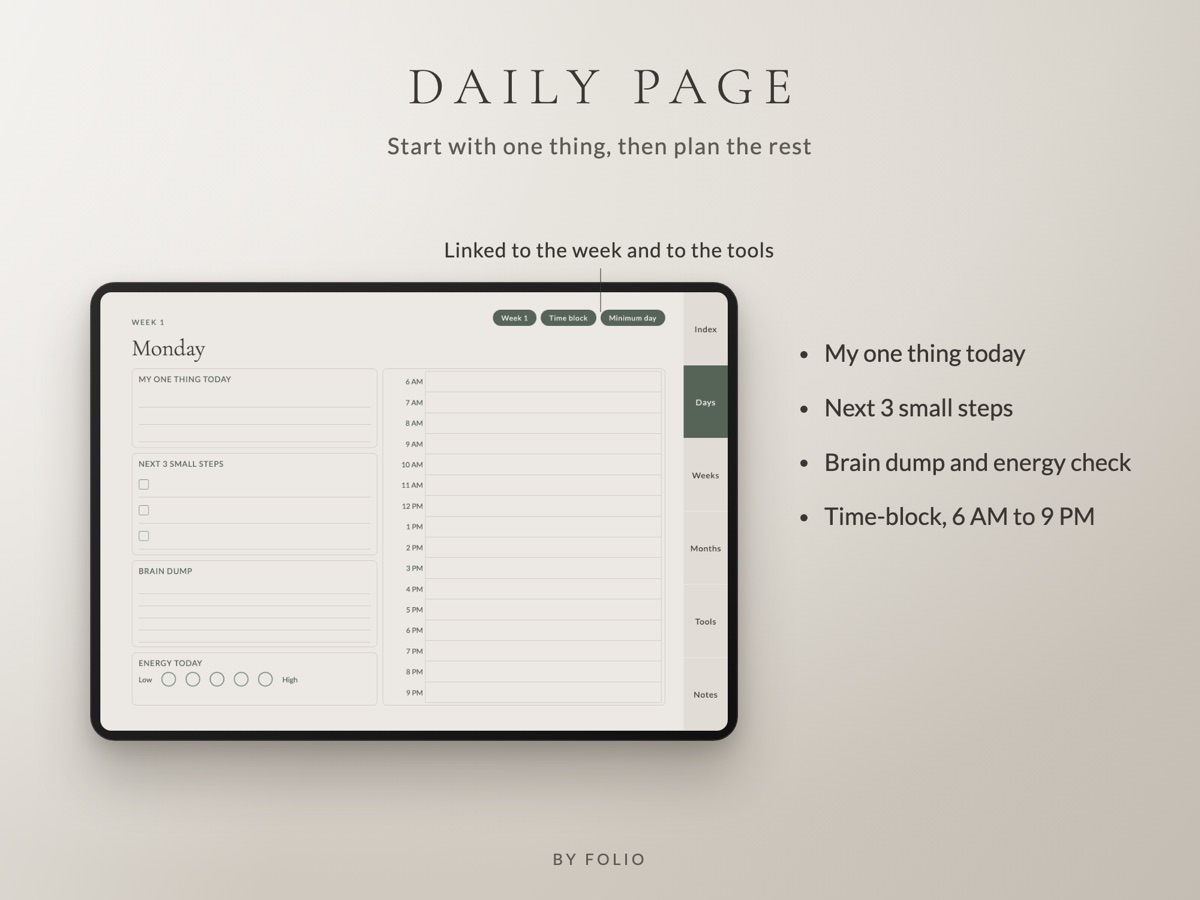
Our Calm Day Planner is designed around exactly this routine. Each of its 168 undated daily pages (24 weeks) has a "my one thing today" box, next 3 small steps, a brain dump, an energy check and a 6 AM to 9 PM time block. Its 19 tool pages include a minimum day, a time-block day, a weekly reset and a routine builder, and it comes in Monday-start and Sunday-start versions with 48 PNG stickers. One printable page of every layout is included in US Letter and A4, so you can also use it on paper. It's a planning layout designed to keep things simple, not a medical or therapeutic tool.
New to undated planners? Here's how to choose between dated and undated planners, and our beginner's guide to digital planners covers setup on a tablet.
This post was drafted with the help of AI and reviewed by the Folio team. The planner it mentions was also designed with the help of AI tools and checked page by page. This article shares general planning tips and is not medical advice.
Questions people ask
What is a one-thing daily planner?
It is a daily page that starts with a single most important task, then a few small next steps, instead of a long to-do list. Everything else goes into a brain dump or a later list.
How do I choose my one thing?
Ask which task would make today feel worthwhile if it were the only thing you finished, or which task would make other tasks easier. Pick something you can make real progress on today.
What counts as a small step?
A step you can start right away and finish in about 5 to 20 minutes, written with a verb, such as "open the budget file" or "write three bullet points for the email".
What if I finish my one thing early?
Great. Choose the next item from your brain dump and repeat the three-small-steps pattern. The method is about starting, not limiting your day.